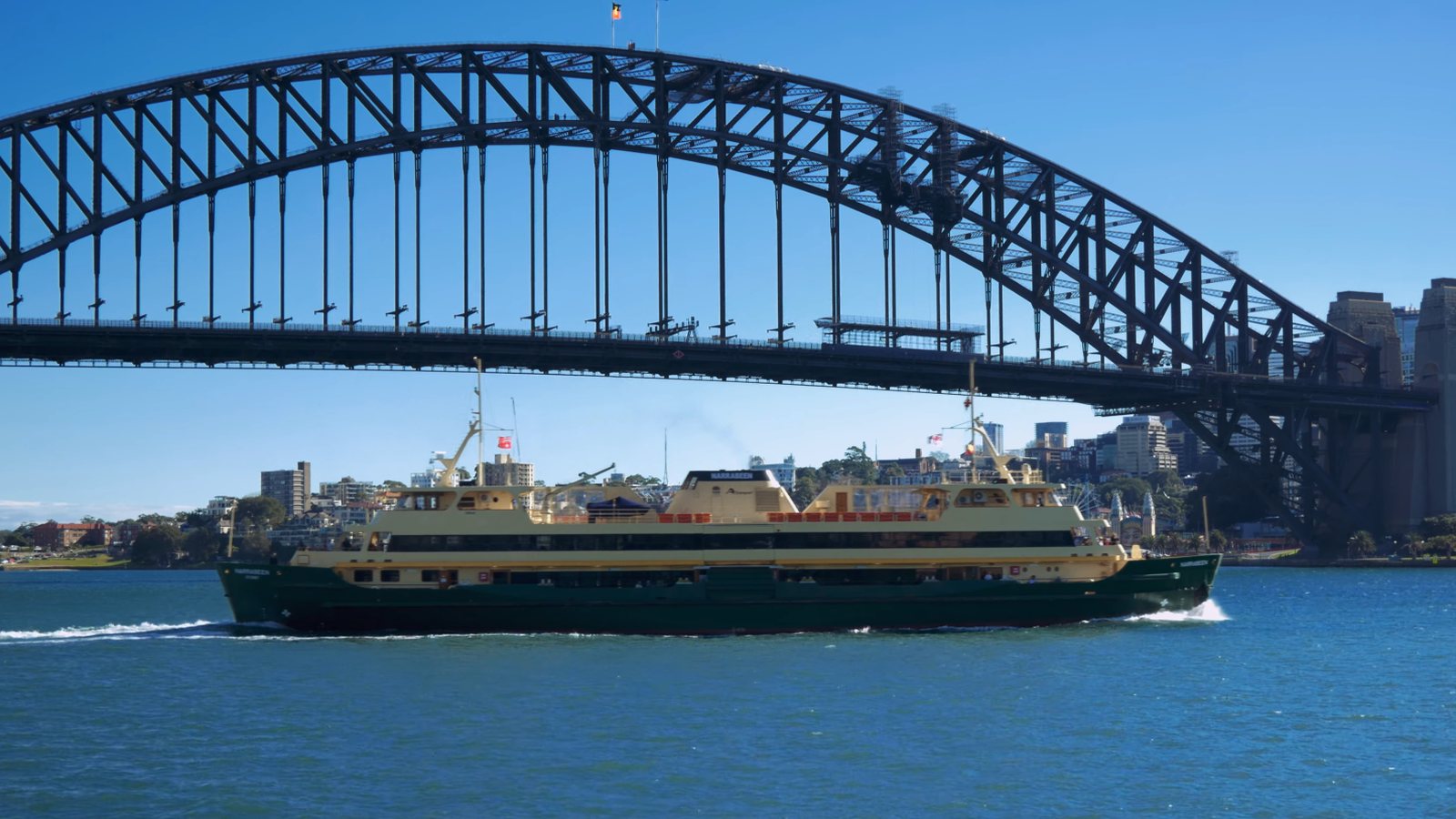
Sydney ferries are part of the city’s public transport system, but they are also one of the easiest ways to see Sydney Harbour.
For visitors, the most useful services include ferries to Manly, Taronga Zoo, Watsons Bay, Cockatoo Island and destinations along the Parramatta River. Sydney Ferries public services accept Opal and contactless payment. Private ferry operators may use different fares, payment devices and booking arrangements.
Quick answer
- Best first-time harbour trip
- F1 Manly from Circular Quay
- Best short harbour trip
- F2 Taronga Zoo, subject to the service pattern
- Best for Taronga Zoo
- F2 public ferry from Circular Quay
- Best long river journey
- F3 Parramatta River
- Best for harbour history
- F8 or F3 to Cockatoo Island
- Payment
- Opal or contactless on Sydney Ferries public services
- Booking
- Normally not required for ordinary public ferries
- Main city interchange
- Circular Quay
- Important
- Private ferries and cruises may use separate tickets and fares
Sydney ferries at a glance
- Network type
- Public transport ferry network
- Main visitor interchange
- Circular Quay
- Other important city wharves
- Barangaroo, Pyrmont Bay and selected Darling Harbour wharves
- Payment
- Opal and contactless on Sydney Ferries services
- Reservations
- Normally not required for ordinary public ferries
- Timetables
- Check the Transport for NSW Trip Planner
- Accessibility
- Check the vessel, both wharves and connecting route
- Weather
- Severe conditions or incidents can change services
Useful ferry trips for visitors
| Destination | Departure area | Typical purpose | Approximate journey | Booking | Best for |
|---|---|---|---|---|---|
| Manly | Circular Quay | Reach Manly and cross the main harbour | Long harbour crossing; check F1 timetable | Normally not required | First-time harbour trip |
| Taronga Zoo | Circular Quay | Reach the Lower Zoo Entrance | About 12 minutes on the service described by Taronga | Normally not required | Zoo visit and short crossing |
| Watsons Bay | Circular Quay | Reach Watsons Bay and nearby walks | Varies by stopping pattern | Normally not required | Eastern harbour destination |
| Cockatoo Island | Circular Quay or Barangaroo | Visit the harbour heritage island | Varies by F3 or F8 service | Normally not required | Harbour history |
| Parramatta | Circular Quay or Barangaroo | Long harbour and river journey | Long, often multi-stop journey | Normally not required | Scenery rather than speed |
| Pyrmont Bay | Circular Quay or Barangaroo connections | Reach Pyrmont and nearby attractions | Short inner-harbour journey; varies | Normally not required | Inner-harbour transport |
| Barangaroo | Circular Quay or river wharves | City interchange and western CBD access | Varies by route and stopping pattern | Normally not required | Western side of the CBD |
How Sydney ferries work
Sydney Ferries are scheduled public transport services across Sydney Harbour and the Parramatta River. Many visitor routes connect through Circular Quay, while Barangaroo, Pyrmont Bay and other wharves are important for particular routes.
Stopping patterns can vary, and a route page may show every possible stop rather than the stops on one particular trip. Use the official Trip Planner for the actual date and departure. Ordinary public services generally do not require advance reservations, but passengers should arrive early enough to find the wharf, tap on and join the queue.
Public ferries, private ferries and harbour cruises
Sydney Ferries public services
These are scheduled public transport services. Opal cards, Opal single tickets and contactless payment are accepted, with standard Opal benefits applying when the correct payment method is used.
Private ferry services
Private operators may use separate tickets, operator fares, booking rules and accessibility arrangements. Some accept OpalPay, which is different from the standard Opal fare system and does not provide every Opal benefit.
Commercial harbour cruises
Cruises are tourism products rather than ordinary public transport. They may include commentary, meals, reserved experiences or sightseeing loops and may leave from different boarding points. Do not assume a cruise ticket or private ferry ticket is interchangeable with a Sydney Ferries fare.
How to pay for a Sydney ferry trip
On Sydney Ferries public services, use an Opal card, an accepted contactless debit or credit card, a compatible phone or watch, or an eligible Opal single ticket. Fares depend on distance and the applicable Opal rules. Contactless users pay an Adult Opal fare unless an eligible concession has been linked beforehand.
Each fare-paying passenger needs a separate payment method. Use the same card or device for the whole trip. Child/Youth and Gold Senior/Pensioner fares require the appropriate Opal card; child single tickets are a back-up where available.
Private operators may use OpalPay or their own tickets. Their fares and benefits can differ. Check official ferry payment information and the current fare rules. Last checked: 13 July 2026.
Finding your ferry at Circular Quay
Circular Quay is the main interchange for many visitor ferry routes and contains several separate wharves. Allocations can change, particularly during construction, major events or disruption. Check the destination and departure time in the Trip Planner, then confirm the current wharf number on the departure display.
- Check the destination and departure time.
- Confirm the wharf number on the live display.
- Tap on before entering the paid wharf area where required.
- Join the correct boarding queue.
- Keep access routes clear.
- Follow staff instructions when services are busy.
Different operators may use different boarding points. Do not rely on an old screenshot or a permanently saved wharf number.
Circular Quay to Manly by ferry
The public F1 Manly route runs between Circular Quay and Manly Wharf and accepts Opal and contactless payment. It provides a long harbour crossing and is useful for reaching Manly without a car. Check the current timetable for journey time, frequency and the final useful return service.
Private fast ferry services also operate to Manly. They use operator-specific ticketing or OpalPay arrangements and may have different boarding points, fares and journey times. Do not compare a private fare with the public F1 fare as if they were the same product.
Manly Wharf connects with local buses and is a walk from The Corso and Manly Beach. Both Circular Quay and Manly are listed as accessible wharves, but check the complete onward route and live service result. Fine-weather weekends and major events can produce queues.
Ferry to Taronga Zoo
The F2 Taronga Zoo public route serves Taronga Zoo Wharf from Circular Quay. Taronga currently describes the crossing as about 12 minutes and directs visitors from Circular Quay Wharf 4, but wharf allocations can change, so check the display on the day.
The wharf is about a three-minute walk from the Lower Zoo Entrance. The ferry fare does not include zoo admission. The former Sky Safari is not operating; visitors can use the Lower Entrance or current bus and seasonal shuttle arrangements described by Taronga. Check zoo closing time, the return ferry and accessibility for the whole route, including the steep site beyond the lower entrance.
Sydney to Parramatta by ferry
The F3 Parramatta River service is a long river journey with multiple possible stops. The exact duration depends on the service pattern. It can be a good choice when the journey is part of the day, but the train may be faster when arrival time matters.
Natural low tides can prevent some ferries from operating between Parramatta and Rydalmere. Transport for NSW publishes monthly affected services and shows replacement buses in the Trip Planner. A bicycle cannot be taken on a replacement bus. Check the outward and return trip before leaving.
Choose the ferry when
- the journey itself is part of the day
- you want to see the harbour and river
- the current timetable suits your plans
Choose the train when
- arrival time matters more
- ferry services are disrupted
- the final convenient return ferry is too early
Ferry to Watsons Bay
The public F9 Watsons Bay route links Circular Quay, Rose Bay and Watsons Bay, with stopping patterns that can vary. Check whether the selected service is direct or stops at Rose Bay and confirm the return service before travelling.
Watsons Bay Wharf provides access to the village and nearby harbour-side walking routes. Coastal viewpoints and other attractions may require a longer walk or bus connection. Fine-weather weekends can be busy, and exposed decks may be affected by wind or rough water. Check the destination wharf and onward terrain rather than assuming the whole visit is accessible.
Ferry to Cockatoo Island
Cockatoo Island’s official visitor information lists the public F3 and F8 services, with departures from Circular Quay, Barangaroo and wharves along the Parramatta River. Check the selected trip because routes and stops vary.
The island is open to the public without a general admission charge, although tours, events and accommodation cost extra. It is an industrial heritage site with uneven surfaces and a steep incline between the lower island and upper plateau, so not every area is accessible even though Cockatoo Island Wharf is listed as accessible. Check opening information, event changes and the return ferry.
Ferries for Barangaroo, Darling Harbour and Pyrmont
Barangaroo and Pyrmont Bay are important city-side ferry wharves. Current routes serving the western side of the CBD include services on the Parramatta River, Pyrmont Bay, Cockatoo Island and Blackwattle Bay corridors, but the stopping sequence and city-side terminus vary.
Darling Harbour is an area rather than one permanent public-ferry wharf name. Check whether Barangaroo, Pyrmont Bay or another current wharf is closest to your destination. Barangaroo is convenient for the western CBD; Pyrmont Bay is useful for Pyrmont attractions and light rail connections. Do not rely on historic wharf names.
Which ferry destination should you choose?
| Traveller wants to visit | Useful ferry destination | Main departure area | Important consideration |
|---|---|---|---|
| Manly Beach | Manly Wharf | Circular Quay | Public and private services use different fares |
| Taronga Zoo | Taronga Zoo Wharf | Circular Quay | The zoo extends uphill beyond the Lower Entrance |
| Parramatta | Parramatta Wharf | Circular Quay or Barangaroo | Long journey and low-tide changes |
| Watsons Bay | Watsons Bay Wharf | Circular Quay | Check the return service |
| Cockatoo Island | Cockatoo Island Wharf | Circular Quay or Barangaroo | Check island access and events |
| Pyrmont attractions | Pyrmont Bay Wharf | Circular Quay or Barangaroo connections | Check the current route pattern |
| Western CBD | Barangaroo Wharf | River and harbour wharves | Confirm the service stops at Barangaroo |
Ferry timetables and frequency
Frequency varies by route, time and day. Weekday, weekend and public-holiday timetables can differ; some routes have peak variations, and not every service stops at every wharf shown on a route page. Major events, low tide and operational changes can also alter services.
A static timetable becomes outdated quickly. Use the Trip Planner for the outward and return journeys and check the selected trip’s stopping sequence. Last checked: 13 July 2026.
Can a Sydney ferry fill up?
Yes. Public ferries have capacity limits, and waiting at the wharf does not guarantee boarding. Busy periods include commuting peaks, fine-weather weekends, school holidays and major harbour events.
For a popular leisure service, arrive with enough time to find the wharf, tap on and join the queue. Allow additional time during major events and fine-weather weekends. Follow the boarding queue and staff instructions; you may need to wait for the next service, and a seat is not guaranteed.
Weather, tides and ferry disruptions
Rain
Ordinary rain does not necessarily stop ferries, but decks, ramps and wharves can be wet.
Strong wind, rough water and fog
Services may be delayed, changed or cancelled when conditions affect safe operation or visibility.
Low tide
Some upper Parramatta River services are replaced by buses between Parramatta and Rydalmere during natural low tides.
Incidents and construction
Harbour incidents, major events and wharf works can cause diversions, closures or different boarding points. Replacement transport may operate but is not guaranteed in every situation.
Check current ferry alerts, the Trip Planner and official weather warnings before travelling.
Planning the return ferry
Do not plan only the outward ferry. Check the final practical return service before you leave. Frequencies can decline in the evening, and public and private operators may have different final departures.
If the last suitable ferry has gone, the alternative may be a bus, train, taxi or rideshare. Check the complete journey back to your accommodation, including the destination wharf’s late-night connections and event-day queues.
Accessible ferry travel
All Sydney Ferries vessels are designed to carry people using essential mobility aids, but several older wharves have steps. A complete journey depends on the departure wharf, destination wharf, vessel, connecting transport and local terrain.
Transport for NSW lists Circular Quay wharves 2 to 5, Barangaroo, Cockatoo Island, Manly, Parramatta, Pyrmont Bay and Taronga Zoo among accessible wharves. Access at some wharves changes with the tide, and the F3 can use replacement buses during low tides. Watsons Bay is not included in the current accessible-wharf list, so check the specific Trip Planner result and official wharf information.
Passengers with disabilities and carers receive priority boarding. Staff can assist with the gangway and direct mobility-aid parking but cannot lift a passenger or operate the aid. Make your needs known before boarding. Valid accredited assistance animals can travel on public transport.
- Vessel
- Check the selected ferry and crew assistance
- Both wharves
- Check current independent or assisted access
- Connections
- Check the whole journey and local terrain
- Low tide
- Ramp gradients and replacement buses may affect access
Ferries with children and prams
Prams travel free. Children aged 3 and under travel free; children aged 4 to 15 use a child fare and the appropriate ticket or Opal card. Each fare-paying passenger needs a separate payment method.
Supervise children closely near the water, hold their hand when they are out of the pram, keep them seated on board and follow crew instructions. Secure the pram with its brake and keep doors and access routes clear. Transport for NSW’s ferry safety guidance advises removing the child and folding the pram when boarding; ask staff for assistance if needed, but do not assume staff can carry it.
Luggage, bicycles and other equipment
Ordinary luggage can be carried when it is safely stowed and does not block aisles, doors or emergency exits. Large suitcases can be awkward on busy services; follow crew directions.
Bicycles and surfboards are permitted free on Sydney Ferries when there is enough safe space, but crew can refuse them for capacity or safety reasons. Remain with the bicycle and use the area identified by crew. Private operators may charge or require advance confirmation. Bikes cannot travel on bus replacements.
Pets may travel on a ferry only with crew permission and in a suitable container; assistance animals with accepted accreditation are allowed. Bulky equipment and private ferry rules should be confirmed before travel.
Common ferry mistakes to avoid
- Assuming every ferry leaves from one Circular Quay wharf: allocations differ and can change.
- Not tapping off where required: use the same card or device and follow the F1 Manly exception shown by Transport for NSW.
- Using one card for several passengers: every fare-paying passenger needs a separate method.
- Confusing a private ferry with Sydney Ferries: tickets, fares and Opal benefits differ.
- Checking only the outward timetable: the return may be less frequent or end earlier.
- Arriving at departure time: allow time to find the wharf, tap on and queue.
- Assuming every service stops everywhere: stopping patterns vary.
- Treating the Parramatta ferry as the fastest route: it is often chosen for the journey.
- Assuming vessel access makes the whole trip accessible: wharves and local terrain matter.
- Relying on an old wharf number: check the live display.
- Expecting outdoor seating: vessel layout, capacity and conditions vary.
Frequently asked questions
Are Sydney ferries public transport?
Can I use a contactless bank card?
Do I need an Opal card?
Do I need to book a public ferry?
Which ferry is useful for broad harbour views?
Which ferry goes to Manly?
How do I reach Taronga Zoo by ferry?
Can I take a ferry to Parramatta?
Do ferries run when it rains?
Can a ferry fill up?
Are Sydney ferries wheelchair accessible?
Can I take a pram on a ferry?
Can I take luggage on a ferry?
Can I take a bicycle on a ferry?
What happens if I miss the last ferry?
Do private ferries use the same fare rules?
Official sources
- Ferry information: Transport for NSW
- Ferry routes and timetables: Transport for NSW
- How to pay for a ferry trip: Transport for NSW
- Accessible ferry travel: Transport for NSW
- Safety when travelling by ferry: Transport for NSW
- Ferry travel alerts: Transport for NSW
- Ferries at low tide and replacement buses: Transport for NSW
- Travelling with prams and young children: Transport for NSW
- Travelling with bikes and surfboards: Transport for NSW
- F1 Manly route: Transport for NSW
- Getting to Taronga Zoo: Taronga Zoo Sydney
- Plan your trip to Cockatoo Island: Cockatoo Island
Practical ferry information last checked
Route information, payment rules and accessibility details were checked on 13 July 2026 against current Transport for NSW, Taronga Zoo and Cockatoo Island sources. Ferry routes, wharves, fares and service arrangements can change. Check the official Trip Planner before travelling.
Facts last checked: 2026-07-13